
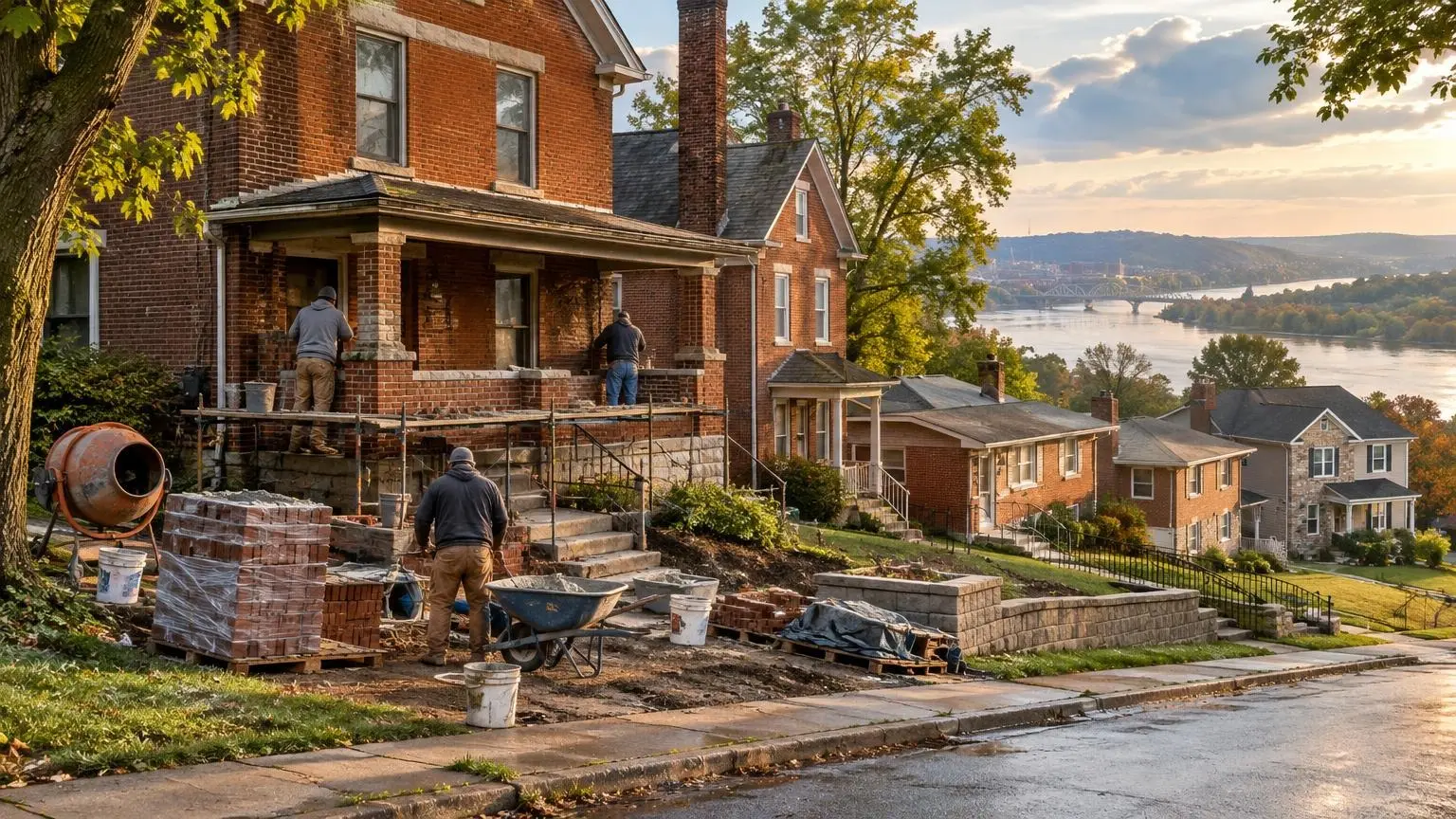
Founded in 1813, with a brick house from 1822 still on Main Street
Masonry Contractors in New Albany, IN
Careful repointing, chimney rebuilds, stone and retaining walls for Floyd County's river city.
- Free on-site look before any price
- Written quote broken out by task
- Mortar chosen to suit the age of your brick
Brick Repair That Respects New Albany's Old Houses
If you are looking for masonry contractors in New Albany, there is a good chance your house is older than most of Louisville's suburbs. Brothers Joel, Abner and Nathaniel Scribner founded the town in July 1813, and the Scribner House, built in 1814, still stands. Today New Albany is the Floyd County seat with 37,841 people at the 2020 census, and its riverfront streets hold one of the region's best collections of 19th-century brick. We repair and repoint brick, rebuild chimneys, work in natural stone, build retaining and garden walls and rebuild steps and stoops.
Mansion Row and the first brick house
The Mansion Row Historic District covers 89 acres along Main Street from State Street to 15th Street, plus a section of Market Street, and was listed on the National Register in 1983. Its list of landmarks reads like a timeline of brick building: the Dr. Asahel Clapp House of 1822, called the first brick house in New Albany, Greek Revival houses from the 1830s and 1840s, Italianate villas from the 1850s and 1860s, and the Second Empire Culbertson Mansion of 1869, now an Indiana state historic site.
On walls like these, the mortar is meant to be the sacrificial part. We rake out only the joints that have failed, use a mortar softer than the brick, and match the color and tooling so the repair disappears into the wall. We avoid sandblasting and high-pressure washing, which strip the hard outer skin from old brick.
East Spring Street and the neighborhoods behind Main
North of downtown, the East Spring Street Historic District covers 32 acres with 84 contributing buildings, mostly late 19th and early 20th century Queen Anne, Italianate and Colonial Revival houses, plus churches from the 1850s. These blocks have the classic problems of old masonry houses: chimneys with eroded tops, porch piers that have shifted, brick foundations with soft joints and front steps that have settled.
Built after the worst flood in the city's history
In January 1937 the Ohio River rose to 60.8 feet at New Albany, and Wikipedia calls the flood the worst disaster to befall the city. Afterward, New Albany was the first city in the region to begin building massive flood walls. Many houses in the lower part of town had their foundations and lower walls soaked for days. Today that history shows up as mortar loss near grade and damp basement walls. We look for where water is still getting in, fix grading and downspouts with you, and repair the masonry so it can breathe.
Chimneys and stoops
A tall brick chimney on a 19th-century house takes a lot of weather. The crown cracks, water gets into the top courses, and freeze and thaw loosen the brick until the top leans or bricks fall. We rebuild from sound brick up, pour or form a new crown with an overhang, set a cap and redo flashing. For stoops and steps, we rebuild on a solid base so the steps stop pulling away from the door.
What we build and repair in New Albany
- Tuckpointing and brick repair with compatible mortar
- Chimney rebuilds, crowns, caps and flashing
- Stone and veneer, including limestone sills and steps
- Retaining walls for sloped yards toward the knobs
- Brick and block walls and foundation repairs
- Steps, stoops and porch piers
Call (502) 443-8557 to set up a visit in New Albany.
New Albany Masonry Facts
- First brick house. The Dr. Asahel Clapp House of 1822 on Mansion Row is described as the first brick house in New Albany.
- Mansion Row. The Mansion Row Historic District covers 89 acres along Main and Market streets and was listed in 1983.
- East Spring Street. The East Spring Street Historic District has 84 contributing buildings on 32 acres.
- 1937 flood. The Ohio River crested at 60.8 feet at New Albany in January 1937, the worst disaster in city history.
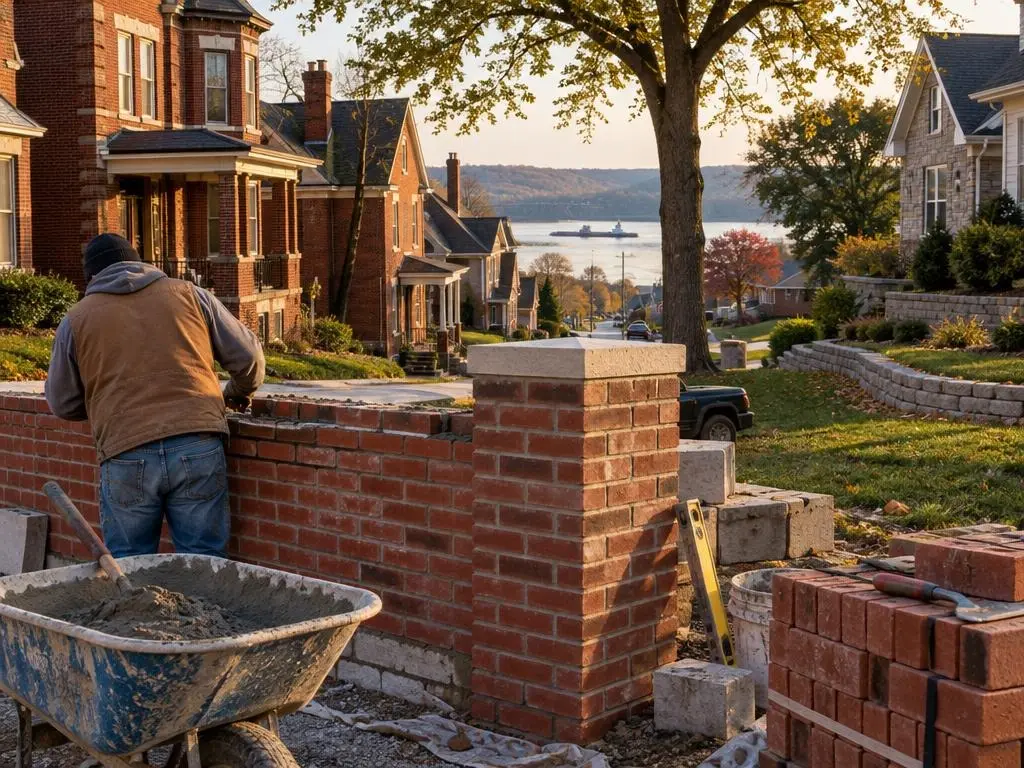
Our Services in New Albany, IN
New Albany Questions
What mortar should be used on a Mansion Row house?
Brick from the 1820s through the 1880s is softer than modern brick, so the mortar should be softer still, usually a lime-rich mix. Hard portland mortar can force cracks into the brick itself. We match the original mortar's color and joint profile too.
Can you clean old brick without damaging it?
Yes, with low pressure and gentle cleaners. We do not sandblast or use high-pressure water on historic brick, because it removes the fired outer surface and lets water in.
My chimney top is leaning. Does the whole chimney need rebuilding?
Usually not. Most leaning tops are caused by water getting in through a failed crown. We take the chimney down to sound brick, rebuild it and add a proper crown and cap.
Free Estimates in New Albany, IN
Tell us about your house in New Albany and what the masonry is doing, and we will book a free on-site estimate.
Masonry Contractors Near New Albany
- Masonry Contractors in Louisville, KY
- Masonry Contractors in Jeffersonville, IN
- Masonry Contractors in Jeffersontown, KY
- Masonry Contractors in Clarksville, IN
- Masonry Contractors in Mount Washington, KY
- Masonry Contractors in St. Matthews, KY
- Masonry Contractors in Shively, KY
- Masonry Contractors in Shepherdsville, KY
- Masonry Contractors in Lyndon, KY
- Masonry Contractors in La Grange, KY
- Masonry Contractors in Middletown, KY
- Masonry Contractors in Hillview, KY
- Masonry Contractors in Crestwood, KY
- Masonry Contractors in Prospect, KY
- Masonry Contractors in Anchorage, KY
- Masonry Contractors in Pewee Valley, KY
- Masonry Contractors in Old Louisville, KY
- Masonry Contractors in Cherokee Triangle, KY
- Masonry Contractors in Crescent Hill, KY
- Masonry Contractors in Butchertown, KY
- Masonry Contractors in Okolona, KY
- Masonry Contractors in Fern Creek, KY
- Masonry Contractors in Valley Station, KY
- Masonry Contractors in Pleasure Ridge Park, KY