
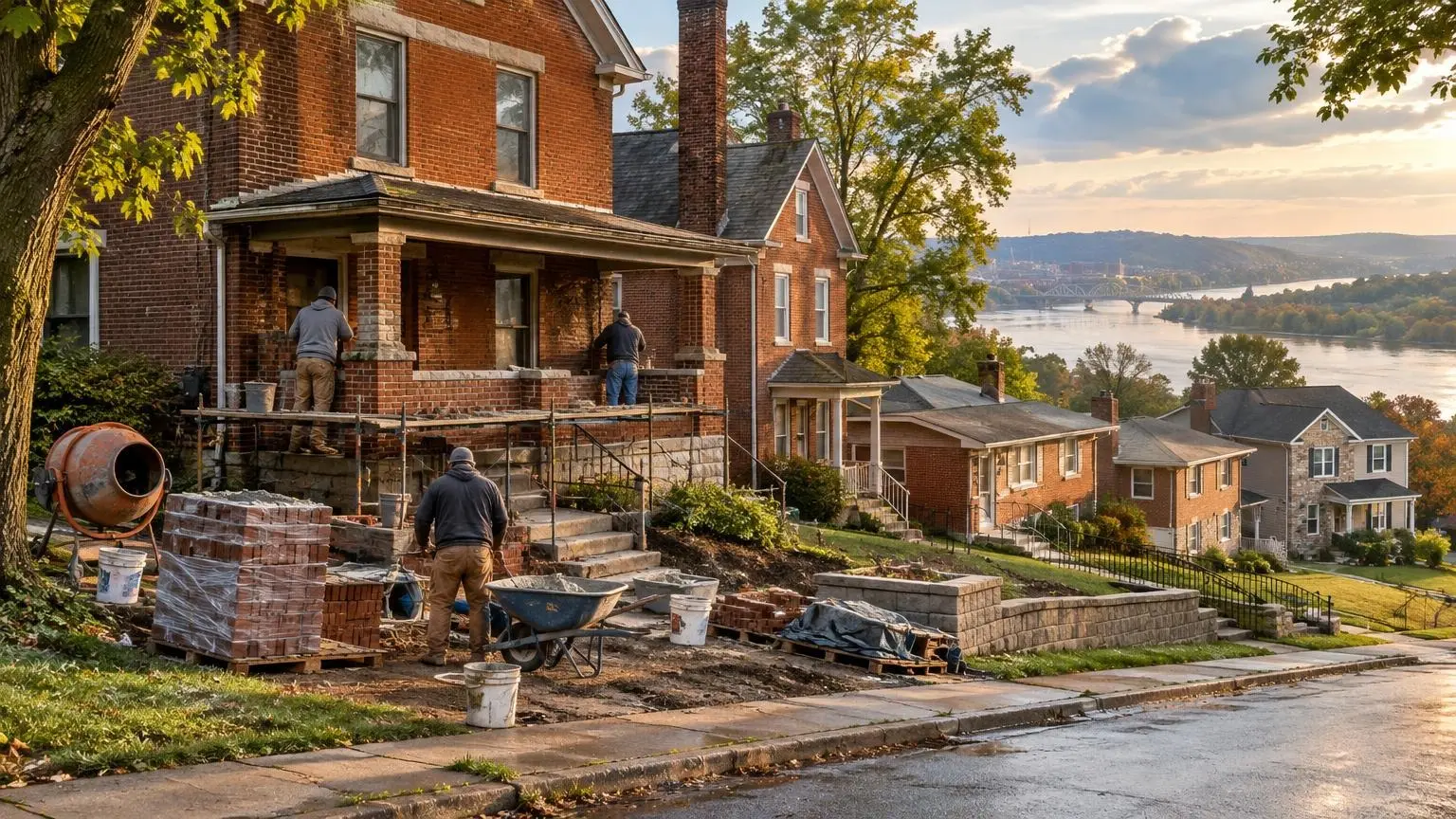
Home of the largest Victorian preservation district in the U.S.
Masonry Contractors in Louisville, KY
Brick repair, tuckpointing, chimneys, stone, retaining walls and steps across Louisville Metro, from Old Louisville to the Knobs.
- Free on-site look before any price
- Written quote broken out by task
- Mortar chosen to suit the age of your brick
Brick and Stone Work for a River City
Louisville is our home market, and masonry contractors here deal with a wider range of walls than most cities ever see. George Rogers Clark founded the settlement in 1778, the city incorporated in 1828, and in 2003 it merged with Jefferson County into a single metro government. The 2020 census counted 633,045 people. Inside that one boundary are Victorian brick mansions with red sandstone trim, cast-iron storefronts on West Main Street, rows of shotgun houses, interwar bungalows and thousands of brick ranches from the decades after World War II. We repoint and repair brick, rebuild chimneys, lay stone and veneer, build retaining walls and block walls, and rebuild front steps and porches.
Old brick needs soft mortar
Wikipedia calls Old Louisville the largest historic preservation district in the country made up solely of Victorian homes and buildings, and the neighborhood's article says most of its structures are brick. Brick fired in the 1800s is softer than modern brick, and it was laid in lime-rich mortar. When someone repoints that kind of wall with a hard, cement-heavy mix, the mortar ends up stronger than the brick, so the brick faces start to crack and spall instead of the joints.
Louisville Metro's own masonry design guidelines say this plainly. Guideline M12 says repointing mortar should be equal to or softer than the original, and M13 says a high-lime, low-portland mix is often acceptable when the original cannot be tested. We follow the same rule on old houses everywhere in the city, whether or not they sit in a district.
Eight local preservation districts
The city's Office of Planning lists eight local preservation districts: Butchertown, Cherokee Triangle, Chickasaw (established in 2025), Clifton, Limerick, Old Louisville, Parkland and West Main Street. In those districts, exterior alterations, demolition and new construction go through design review, and work needs a Certificate of Appropriateness before a building permit is issued. Staff or an Architectural Review Committee handles the review, with oversight from the Historic Landmarks and Preservation Districts Commission. If your house is in one of them, we put the masonry scope in writing early so the review has what it needs.
Freeze, thaw and a lot of rain
Louisville's climate is humid subtropical, but it still freezes. Wikipedia lists an average first freeze on November 2 and a last freeze on April 5, with about four and a half nights a year at 10 degrees or colder, and roughly 45 inches of precipitation a year. That combination is hard on masonry. Water soaks into open joints and cracked crowns, freezes, expands and pushes pieces apart. The damage shows up first where water collects: chimney crowns, the tops of garden walls, step treads, window sills and the bottom courses of a wall near a downspout.
Most repairs we quote in Louisville start with water. Before we rebuild anything, we look at where the water comes from: a missing chimney cap, a gutter dumping onto a stoop, soil sloped toward a foundation or a wall without weep holes.
Retaining walls and permits
Louisville Metro Construction Review says retaining walls over 4 feet tall need a building permit, and walls under 4 feet, measured from the bottom to the top, are exempt. The east side of the county rises onto rolling hills above the Ohio River floodplain, and the Knobs region lies in the far south, so many yards there need terracing. For walls near or over that height, we plan for the permit, the drainage behind the wall and the footing before we price it. If your property is in one of the smaller home-rule cities inside Metro, that city may need its own approval too.
Louisville made its own mortar
The Louisville Cement Company, whose records are held by the Filson Historical Society, traces its history to the early 1800s and invented Brixment, a masonry cement used for brick and concrete block. It is a reminder that a lot of the city's brickwork was built with local material and local methods. When we match an old joint, we look at its color, sand and tooling and mix to match rather than reaching for whatever is on the shelf.
What we do across Louisville
- Brick repair and tuckpointing: raking out failed joints and repointing with a compatible mortar
- Chimney repair: crowns, caps, flashing, rebuilt tops and leaning stacks
- Stone and veneer: natural stone walls, limestone repair, veneer on new and old homes
- Retaining walls: block, stone and brick walls with drainage behind them
- Brick and block construction: garden walls, foundation repairs, mailbox columns and additions
- Steps and porches: brick stoops, stone steps and porch rebuilds
Call (502) 443-8557 to set up a visit anywhere in Louisville Metro.
Louisville Facts That Shape a Masonry Job
- Preservation districts. Louisville Metro has eight local preservation districts where exterior masonry changes need a Certificate of Appropriateness.
- Victorian brick. Old Louisville is described as the largest U.S. preservation district made up solely of Victorian homes, most of them brick.
- Retaining wall permit. Metro Construction Review requires a building permit for retaining walls over 4 feet tall; shorter walls are exempt.
- Freeze window. Average first freeze is November 2 and last freeze is April 5, with about 4.5 nights a year at 10 degrees or below.
- Local mortar. The Louisville Cement Company, dating to the early 1800s, invented Brixment masonry cement for brick and block.
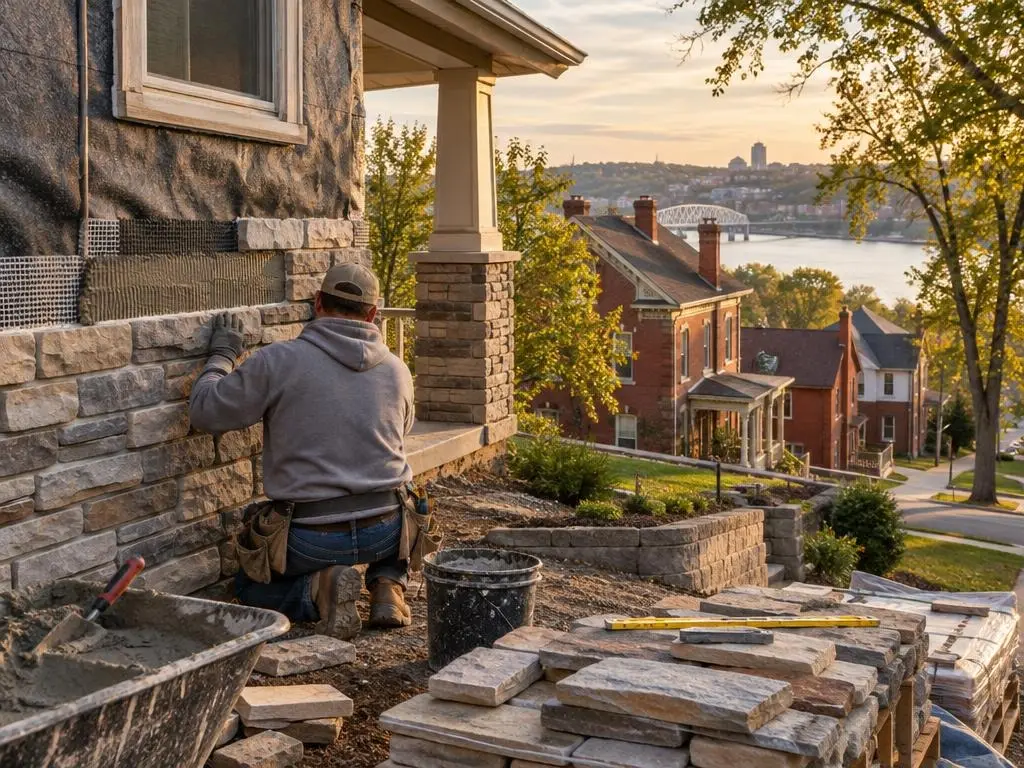
Our Services in Louisville, KY
Louisville Questions
Do I need a permit for a retaining wall in Louisville?
Louisville Metro requires a building permit for retaining walls over 4 feet tall, measured from the bottom of the wall to the top. Shorter walls are exempt from the building permit, though a home-rule city or a preservation district may still have its own review.
Why is my brick crumbling after it was repointed?
The most common cause on older Louisville houses is mortar that is harder than the brick. Metro's masonry guidelines call for repointing mortar equal to or softer than the original. We match the mortar to the brick so the joint, not the brick, takes the movement.
Does work in a preservation district take longer?
It can. Exterior masonry changes in the eight local districts need a Certificate of Appropriateness, approved by staff or an Architectural Review Committee, before a building permit. Like-for-like repairs are often simpler than new construction or demolition.
Free Estimates in Louisville, KY
Tell us your street and what the brick, stone or chimney is doing, and we will set up a free estimate anywhere in Louisville.
Masonry Contractors Near Louisville
- Masonry Contractors in Jeffersonville, IN
- Masonry Contractors in New Albany, IN
- Masonry Contractors in Jeffersontown, KY
- Masonry Contractors in Clarksville, IN
- Masonry Contractors in Mount Washington, KY
- Masonry Contractors in St. Matthews, KY
- Masonry Contractors in Shively, KY
- Masonry Contractors in Shepherdsville, KY
- Masonry Contractors in Lyndon, KY
- Masonry Contractors in La Grange, KY
- Masonry Contractors in Middletown, KY
- Masonry Contractors in Hillview, KY
- Masonry Contractors in Crestwood, KY
- Masonry Contractors in Prospect, KY
- Masonry Contractors in Anchorage, KY
- Masonry Contractors in Pewee Valley, KY
- Masonry Contractors in Old Louisville, KY
- Masonry Contractors in Cherokee Triangle, KY
- Masonry Contractors in Crescent Hill, KY
- Masonry Contractors in Butchertown, KY
- Masonry Contractors in Okolona, KY
- Masonry Contractors in Fern Creek, KY
- Masonry Contractors in Valley Station, KY
- Masonry Contractors in Pleasure Ridge Park, KY